Ph.D. student’s work aims to expand pharmacist clinical services in Virginia
Dec. 17, 2025
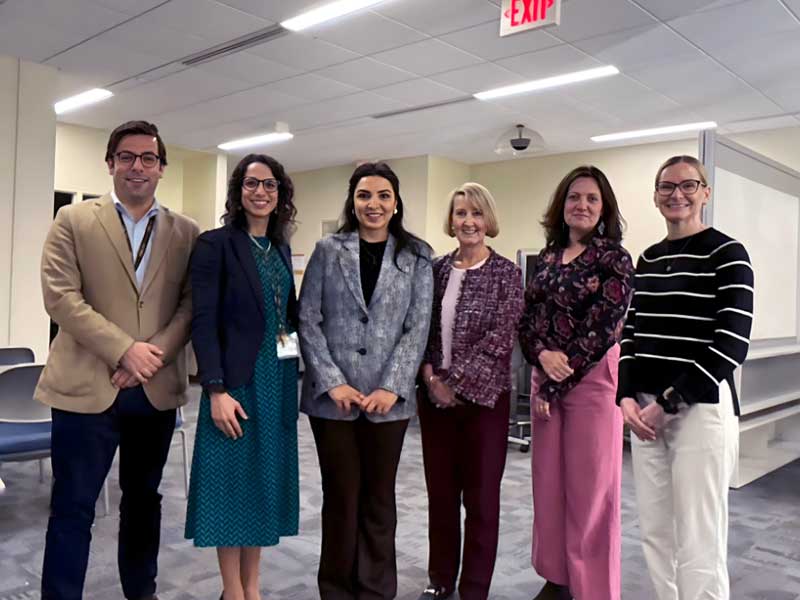
Rana Amayreh, a Ph.D. student at VCU School of Pharmacy’s Center for Pharmacy Practice Innovation, successfully defended her Ph.D. dissertation on Nov. 24, officially completing her Ph.D. in Pharmaceutical Sciences with a concentration in Pharmacoeconomics and Health Outcomes. Her research focused on increasing uptake of statewide protocols and Medicaid billing of community-based pharmacist services in Virginia.
Amayreh’s research interest emerged after Virginia legislature allowed for the expansion of pharmacists' clinical services beginning in 2020.
In 2023, Virginia took another step to expand clinical services by requiring Medicaid to pay pharmacists for services delivered under statewide protocols, ensuring pharmacists would be compensated for the expanded clinical services they provide. However, the complexity of Medicaid credentialing and billing processes created practical barriers that prevented many pharmacists from taking advantage of the opportunity, as only 24% of Virginia pharmacists reported using at least one statewide protocol, with minimal pharmacist registration as Medicaid providers.
To better understand these implementation gaps, Amayreh, advised by Teresa Salgado, Ph.D., director of the Center, conducted two qualitative studies. The first study examined barriers to utilizing statewide protocols in community practice, while the second focused specifically on challenges pharmacists faced with Medicaid credentialing and billing.
Both studies – “Implementation of Statewide Protocols for Community-Based Pharmacist Services in Virginia: A Qualitative Study Using the Consolidated Framework for Implementation Research” and “Contextual Factors Affecting Implementation of Medicaid Billing for Community-Based Pharmacist Services in Virginia: A Qualitative Study” – revealed similar barriers limiting pharmacists’ ability to fully utilize expanded clinical services.
While statewide protocols could help expand health care access, the studies found that limited resources, workflow challenges and the unique needs of different pharmacy settings have made implementation difficult. Medicaid billing faces even greater barriers, including procedural complexity, knowledge gaps among pharmacists regarding the credentialing and billing processes and inadequate infrastructure.
“While my research focused on identifying those barriers, I also wanted to develop practical solutions to help pharmacists overcome them so these services could reach the patients who need them most,” Amayreh shared.
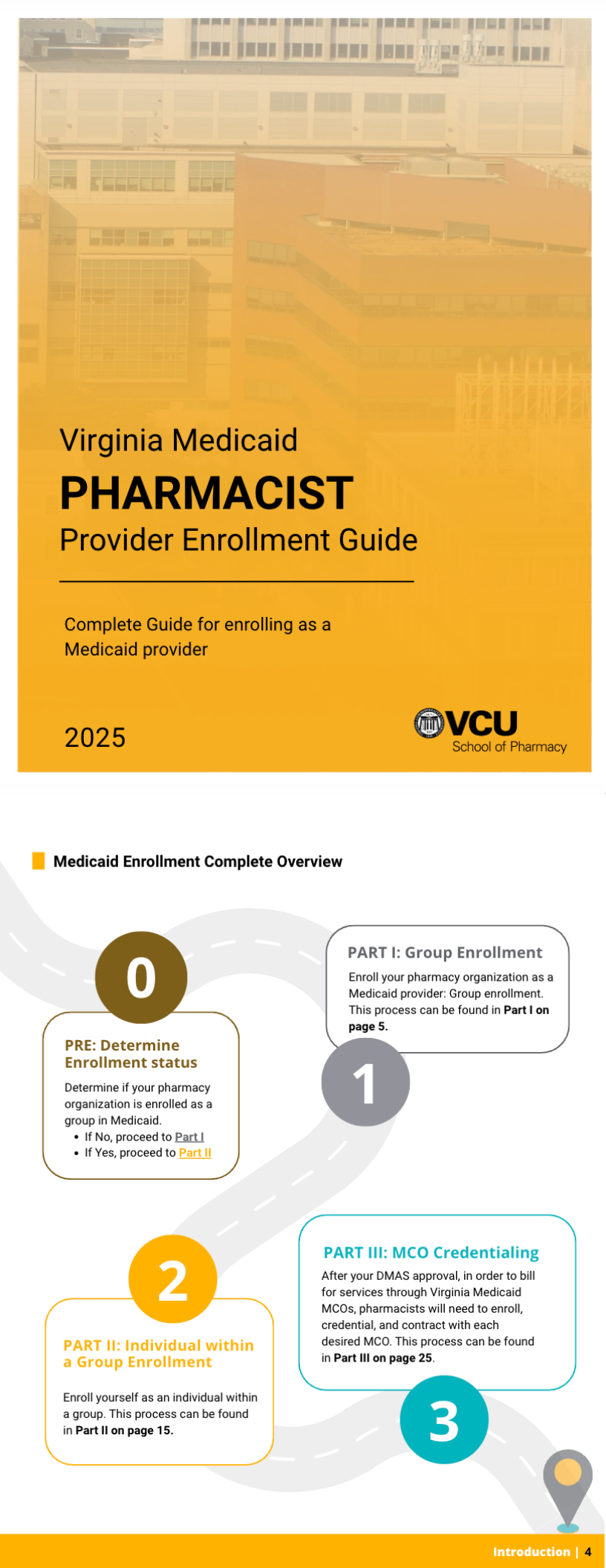 Amayreh, in conjunction with Salgado and the CPPI team, has developed – and is in the final stages of testing – a user-friendly toolkit designed to help community pharmacists navigate the complex Medicaid credentialing process.
The toolkit, the Virginia Medicaid Pharmacist Provider Enrollment Guide, breaks the process into three parts:
Part I. Group Enrollment: Enrolling your pharmacy as a Medicaid provider.
Part II. Individual Within a Group Enrollment: Enrolling yourself as an individual provider within your pharmacy (group).
Part III. Credentialing With Individual Managed Care Organizations: Once enrolled as an individual within a group, credentialing is required to receive payment for services delivered through statewide protocols or collaborative practice agreements (CPAs).
“My hope is to provide both the evidence base for understanding implementation barriers and practical tools that can facilitate adoption of pharmacist-provided clinical services,” Amayreh said. “By combining implementation science frameworks with human-centered design, we’ve created a resource that directly addresses challenges that pharmacists face in daily practice. Seeing my research translate into practical resources that pharmacists can use immediately has made the work very rewarding.”
Upon graduation, Amayreh is focusing her efforts on finalizing and piloting the toolkit so pharmacists across the Commonwealth of Virginia can use it to enroll as Medicaid providers and implement these services, ultimately helping more patients benefit from expanded pharmacist clinical services.
Amayreh expressed gratitude to her advisors and supporters, sharing, “Dr. Salgado and my committee members were incredible throughout this journey. Dr. Salgado was more than an academic advisor, guiding me thoughtfully through every step of the research while also supporting me through personal challenges along the way. That kind of mentorship, where someone sees you as a whole person and not just a researcher, made all the difference. Her guidance has shaped not only this work but also the kind of researcher and person I want to be.”
Practicing pharmacists interested in helping test the toolkit’s effectiveness can contact the team at cppi@vcu.edu. Participation in this study includes:
- Receiving access to the toolkit for six weeks.
- Using the toolkit to guide you through the Medicaid provider registration process.
- Completing a brief survey (10–15 minutes) about your experience with the toolkit.